Are you working on something interesting, share your story with us!
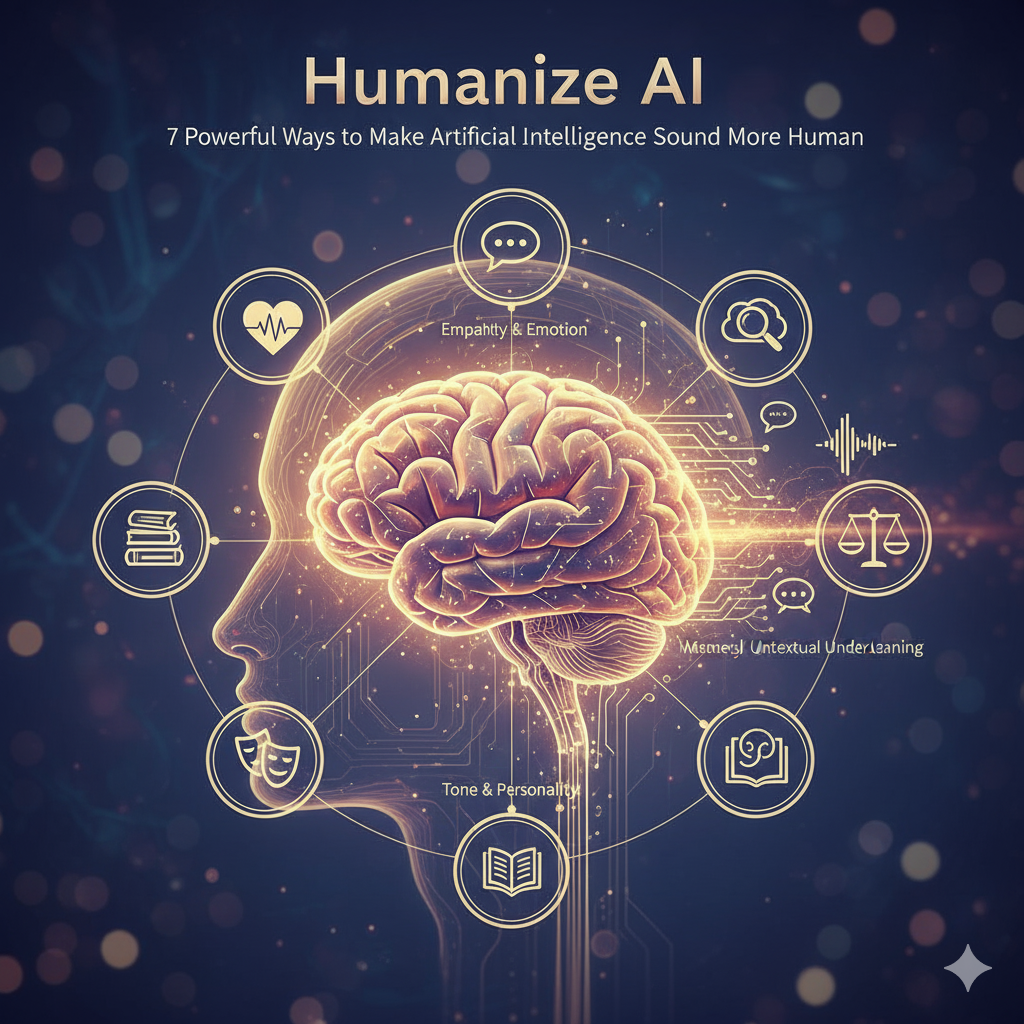
Artificial Intelligence (AI) has quickly become part of our daily lives. From chatbots and virtual assistants to smart recommendations on e-commerce platforms, AI is everywhere. But there’s one ongoing challenge—AI often feels robotic, repetitive, and unnatural. This is where the concept of Humanize AI comes in.
Humanizing AI means designing, training, and fine-tuning AI systems so they communicate more like people—empathetic, natural, and engaging. This doesn’t just make AI interactions more pleasant; it also boosts trust, usability, and effectiveness across industries like customer service, healthcare, and education.
In this article, we’ll explore seven powerful ways to humanize AI and why making AI more human-centered is essential for the future of technology.
1. Improving Natural Language Processing (NLP)
The foundation of any AI-human interaction is language. Traditional AI models often respond with generic or rigid text that lacks context. With advancements in Natural Language Processing (NLP), AI can now:
- Understand tone, intent, and slang.
- Adjust responses to feel conversational rather than mechanical.
- Handle complex queries while maintaining clarity.
For example, instead of replying “Invalid input,” a humanized AI might say:
“Hmm, I didn’t quite get that. Could you try rephrasing your question?”
This small tweak creates warmth and relatability, making the interaction more human.
2. Adding Emotional Intelligence
To humanize AI, we must teach it empathy and emotional understanding. Emotional AI can detect user mood through text patterns, voice tone, or facial expressions. For instance:
- A customer sounding frustrated could trigger the AI to respond more sympathetically.
- A cheerful tone might prompt a more casual and friendly reply.
Emotional intelligence in AI doesn’t just improve user satisfaction—it also builds trust. When people feel understood, they are more likely to adopt AI-driven services.
3. Personalization and Context Awareness
Nobody likes a “one-size-fits-all” response. Humanized AI should be personalized based on user history, preferences, and context. For example:
- A fitness chatbot could remember your previous workout and suggest the next one accordingly.
- An AI tutor could recall what topics you struggled with last week and tailor lessons to your learning pace.
This kind of context awareness makes AI interactions feel less like a machine and more like a knowledgeable assistant who knows you personally.
4. Using Conversational Design
Conversation is not just about words; it’s about flow, tone, and structure. Humanizing AI requires conversational design, which includes:
- Small talk & fillers: “That’s interesting!” or “Let me think about that…”
- Turn-taking cues: Ensuring smooth back-and-forth exchanges.
- Politeness & gratitude: Saying “thank you” or “you’re welcome” when appropriate.
Well-designed conversational flows reduce friction and make AI interactions enjoyable—almost like chatting with a friend.
5. Ethical and Transparent Communication
A big part of sounding human is being honest and transparent. Instead of pretending to be human, a humanized AI should:
- Admit its limitations: “I don’t know that yet, but I can help you find the answer.”
- Avoid misleading or biased outputs.
- Clearly disclose when users are interacting with AI.
Transparency builds credibility, ensuring that people see AI not as a “trickster” but as a trustworthy companion.
6. Incorporating Voice and Tone Modulation
Voice assistants like Siri, Alexa, and Google Assistant have already introduced a sense of familiarity. But humanizing AI means going a step further:
- Using tone variation to avoid sounding monotone.
- Offering different voice personalities (professional, friendly, playful).
- Recognizing when to speak faster, slower, or more empathetically based on user emotion.
By sounding natural and expressive, AI voice systems become more engaging, less robotic, and closer to human conversation.
7. Balancing Efficiency with Humanity
While speed and accuracy are important, AI should also learn the art of human pacing. Sometimes, instant answers feel unnatural. Adding a slight pause or processing cue—like “Let me check that for you…”—can make AI responses feel more authentic.
This balance between efficiency and natural interaction ensures that users feel heard, respected, and valued—not just “processed.”
Why Humanizing AI Matters?
- Customer Experience: Humanized AI improves satisfaction in industries like e-commerce, hospitality, and healthcare.
- Education: AI tutors that adapt and empathize can make learning more effective.
- Business Productivity: Employees using AI assistants feel more supported when responses are natural and empathetic.
- Trust in Technology: People are more likely to adopt AI when it communicates in a friendly, transparent, and relatable way.
As AI continues to integrate into daily life, humanizing AI isn’t just a luxury—it’s a necessity.
Conclusion
AI has come a long way, but its future lies in becoming more human-centered. By improving language understanding, emotional intelligence, personalization, conversational design, transparency, voice expression, and pacing, we can create AI systems that feel less like machines and more like true digital companions.
The goal of humanizing AI is not to replace people, but to make technology more approachable, trustworthy, and effective. In short, the more we humanize AI, the more powerful and impactful it becomes.