Are you working on something interesting, share your story with us!
When it comes to starting a business, one of the most critical decisions every entrepreneur faces is choosing the right business structure. Among the various options—sole proprietorships, partnerships, LLCs, and corporations—the C-Corporation (C-Corp) stands out as a powerful choice for startups and entrepreneurs looking to scale.
A C-Corp is a legal business structure that separates the owners (shareholders) from the company itself. This means the corporation has its own legal identity, can enter into contracts, own property, and be held liable for its actions. Although forming and maintaining a C-Corp requires more compliance compared to other structures, the long-term benefits make it worth the effort.
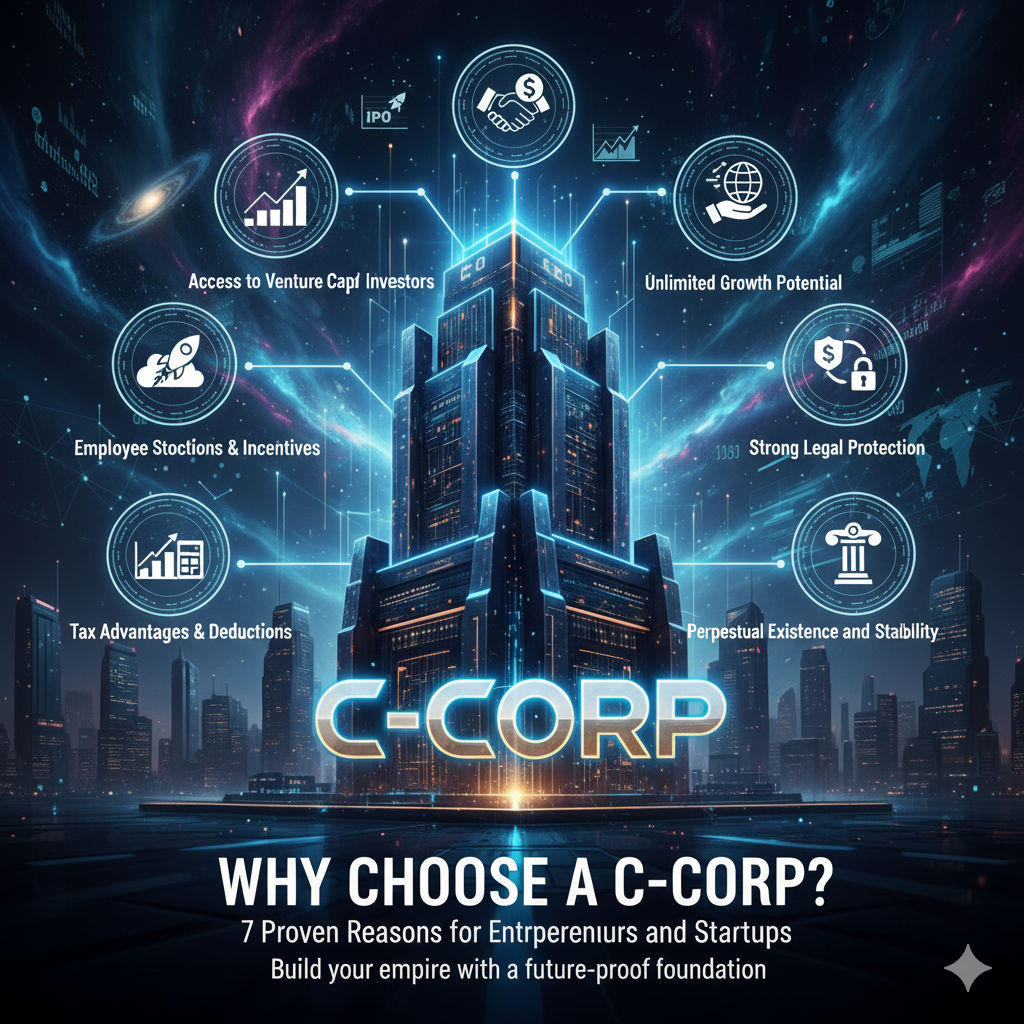
In this article, we’ll dive into 7 proven reasons why entrepreneurs and startups should consider forming a C-Corp in 2025.
1. Access to Venture Capital and Investors
One of the biggest advantages of a C-Corp is its ability to attract investors easily. Most venture capital firms, angel investors, and institutional backers prefer investing in C-Corps over LLCs or sole proprietorships.
- Why? Because C-Corps allow for multiple classes of stock, provide limited liability protection, and are subject to clear federal tax rules.
- Startups aiming for rapid growth and scalability often require significant external funding. A C-Corp structure ensures investors feel secure in their ownership rights.
- If your ultimate goal is to go public (IPO), forming a C-Corp is practically essential.
Simply put, if raising capital is part of your strategy, a C-Corp is your best bet.
2. Unlimited Growth Potential
C-Corps are designed for scaling businesses. Unlike S-Corps or LLCs, which face restrictions on ownership, C-Corps can have:
- Unlimited shareholders (including foreign individuals and entities).
- Multiple classes of stock (common and preferred shares).
- The ability to issue stock options as part of employee compensation.
This flexibility makes it easier to grow, expand internationally, and offer equity incentives to attract top talent. For startups that dream big, the C-Corp structure is built to support that vision.
3. Strong Legal Protection
A C-Corp provides a clear separation between personal and business assets. Shareholders (owners) are not personally liable for the debts or legal issues of the company.
- If the corporation is sued or faces financial difficulties, shareholders only risk the amount they’ve invested.
- Personal assets such as homes, cars, or savings accounts remain protected.
For entrepreneurs, this layer of legal protection provides peace of mind, especially in industries with higher risk exposure.
4. Tax Advantages and Deductions
While C-Corps are subject to double taxation (corporate tax + shareholder dividends), recent changes in U.S. corporate tax law have made this structure attractive again.
- Flat 21% corporate tax rate: After the 2017 Tax Cuts and Jobs Act, C-Corps benefit from a competitive federal tax rate compared to higher individual tax brackets.
- Deductible business expenses: C-Corps can deduct expenses such as salaries, health benefits, retirement contributions, and operational costs.
- Reinvestment potential: Companies that plan to reinvest profits into growth rather than paying out dividends can reduce the impact of double taxation.
For startups that need to retain earnings for scaling, these tax advantages are highly beneficial.
5. Perpetual Existence and Stability
Unlike sole proprietorships or partnerships, a C-Corp enjoys perpetual existence.
- The corporation continues to exist even if founders leave, sell their shares, or pass away.
- This provides stability to investors, employees, and business partners.
- Long-term projects, contracts, and strategic partnerships are easier to secure with a structure that guarantees continuity.
For entrepreneurs building companies with long-term vision, perpetual existence makes the C-Corp especially appealing.
6. Easier Path to IPO
If your startup’s ultimate goal is to go public, forming a C-Corp is a must.
- Public companies in the U.S. are required to be structured as C-Corps.
- The ability to issue stock to the public market makes fundraising on a massive scale possible.
- Going public allows founders and early investors to unlock liquidity, while giving the company access to capital for global expansion.
Companies like Google, Facebook (Meta), and Apple all started as C-Corps before their IPOs. For entrepreneurs with similar aspirations, this is the natural path.
7. Employee Stock Options and Incentives
Attracting and retaining top talent is a challenge for every startup. C-Corps make it easier through stock option plans.
- Employees can be rewarded with equity in the company, aligning their interests with business growth.
- Startups competing with larger corporations for talent can offer stock incentives as a strong motivator.
- Equity-based compensation is a common practice in Silicon Valley and global startup hubs.
This ability to share ownership makes C-Corps ideal for building strong teams driven by long-term success.
Potential Challenges of a C-Corp (and How to Manage Them?)
While the benefits are compelling, entrepreneurs should also be aware of the challenges:
- Double taxation: Both corporate profits and shareholder dividends are taxed. (Solution: Reinvest profits strategically and manage dividend distribution.)
- Higher compliance costs: C-Corps must follow strict reporting, record-keeping, and filing requirements. (Solution: Hire a qualified accountant and legal advisor.)
- Complex formation process: Setting up a C-Corp requires more paperwork than LLCs or partnerships. (Solution: Use professional formation services to simplify the process.)
With proper planning and support, these challenges can be minimized, allowing startups to focus on growth.
Final Thoughts
Choosing the right business structure is one of the most important decisions an entrepreneur will make. While LLCs and S-Corps offer simplicity, the C-Corp shines when it comes to growth, scalability, investor attraction, and long-term success.
For startups aiming to secure venture capital, expand globally, or eventually go public, forming a C-Corp provides the best foundation. The advantages—from tax benefits to legal protection and perpetual existence—make it the structure of choice for ambitious entrepreneurs.
So if you’re ready to take your business idea to the next level, ask yourself: “Is my startup built for growth?” If the answer is yes, then forming a C-Corp may be the smartest move you can make in 2025.